
USS Iowa History: From the First Iowa to Battleship IOWA and SSN-797
The name USS Iowa connects more than 160 years of American naval history. It has been assigned to a fast Civil War-era steam frigate, a pioneering pre-dreadnought battleship, an unfinished battleship canceled after World War I, the legendary Battleship IOWA (BB-61), and a modern Virginia-class nuclear-powered attack submarine.
Five U.S. naval vessels have carried or been assigned the name Iowa, but only three were commissioned into active service as USS Iowa: Battleship No. 4, Battleship BB-61, and submarine SSN-797.
Today, the story continues in two places. USS Iowa (SSN-797) serves the nation beneath the sea, while Battleship IOWA (BB-61) serves the public in Los Angeles as the historic platform of the National Museum of the Surface Navy.
Before BB-61: the earlier Iowas
The first vessel assigned the name Iowa: USS Ammonoosuc
The first U.S. naval vessel assigned the name Iowa began as USS Ammonoosuc, a Wampanoag-class wooden screw frigate laid down at the Boston Navy Yard during the Civil War. Launched on July 21, 1864, she was designed for extraordinary speed at a time when the Union feared both Confederate commerce raiders and the possibility of conflict with Great Britain.
During trials in 1868, Ammonoosuc sustained more than 17 knots—remarkable performance for a wooden steam warship of her time. She was renamed Iowa on May 15, 1869, but was never commissioned under that name. On October 13, 1870, the Navy restored the name Ammonoosuc. She remained out of active service and was sold in 1883.
This ship is included in the Iowa lineage because the Navy officially assigned her the name, even though she never entered commissioned service as USS Iowa.
Read the Naval History and Heritage Command history of Ammonoosuc
USS Iowa (Battleship No. 4 / BB-4)
The first commissioned USS Iowa was a pre-dreadnought battleship built by William Cramp & Sons in Philadelphia. Her keel was laid on August 5, 1893; she was launched on March 28, 1896; and she was commissioned on June 16, 1897.
Iowa represented an important step in American battleship design. Unlike the earlier Indiana-class ships, she was built with greater freeboard and improved seaworthiness for operations on the open ocean. Armed with four 12-inch guns and eight 8-inch guns, she reflected the transition of the United States Navy from a primarily coastal-defense force toward a fleet able to operate farther from home.
When the Spanish-American War began in 1898, Iowa joined operations in the Caribbean. She took part in the bombardment of San Juan, Puerto Rico, blockaded Cuba, and fought in the Battle of Santiago de Cuba on July 3, 1898. During that decisive engagement, the American fleet destroyed the Spanish squadron attempting to escape Santiago harbor. Iowa engaged several Spanish ships and helped rescue Spanish sailors after the battle.
Following the war, Iowa served with the Pacific, South Atlantic and North Atlantic squadrons. She later became a training ship for Naval Academy midshipmen and naval militia crews. Reactivated during World War I, she served as a receiving, training and guard ship rather than deploying to the European combat zone.
After her final decommissioning in 1919, she was renamed Coast Battleship No. 4 and converted into one of the Navy’s earliest radio-controlled target ships. She survived aerial bombing tests in 1921 and was sunk by gunfire from USS Mississippi during Fleet Problem I off Panama on March 23, 1923.
USS Iowa (BB-53): the battleship that was never completed
The next USS Iowa was planned as BB-53, one of six South Dakota-class battleships authorized during World War I. These ships would have been larger and more heavily armed than the preceding Colorado class, with a main battery of twelve 16-inch guns in four triple turrets.
BB-53’s keel was laid at Newport News Shipbuilding on May 17, 1920. Construction stopped after the United States signed the Washington Naval Treaty of 1922, which limited battleship construction among the world’s major naval powers. The Navy canceled Iowa on February 8, 1922, while the ship was still incomplete, and her unfinished hull was sold for scrap in 1923.
Although BB-53 never reached the fleet, her cancellation marked the beginning of a long pause in American battleship construction. The next ship to receive the Iowa name would emerge from a very different strategic world on the eve of World War II.
USS Ammonoosuc renamed Iowa
Never commissioned; name changed back to Ammonoosuc in 1870.
USS Iowa (Battleship No. 4 / BB-4)
Pre-dreadnought battleship. Served in the Spanish-American War and World War I era; sunk as a target in 1923.
USS iowa (BB-53)
South Dakota-class battleship. Construction canceled under the Washington Naval Treaty; scrapped incomplete.
USS iowa (BB-61)
Iowa-class fast battleship. Served in World War II, Korea and the Cold War; preserved as a museum in Los Angeles.
USS Iowa (SSN-797)
Virginia-class nuclear-powered attack submarine. Commissioned April 5, 2025; active U.S. Navy submarine.
Battleship IOWA (BB-61): the Battleship of Presidents
Designing America’s fast battleship
Congress authorized a new class of battleships as war spread across Europe and Asia. The Navy needed ships with the speed to operate alongside fast aircraft carriers, the range to cross the Pacific, and the firepower and armor expected of a capital ship.
The result was the Iowa class—the final class of battleships completed for the United States Navy. USS Iowa (BB-61) was the lead ship, followed by USS New Jersey (BB-62), USS Missouri (BB-63), and USS Wisconsin (BB-64). Two additional ships, Illinois (BB-65) and Kentucky (BB-66), were begun but never completed.
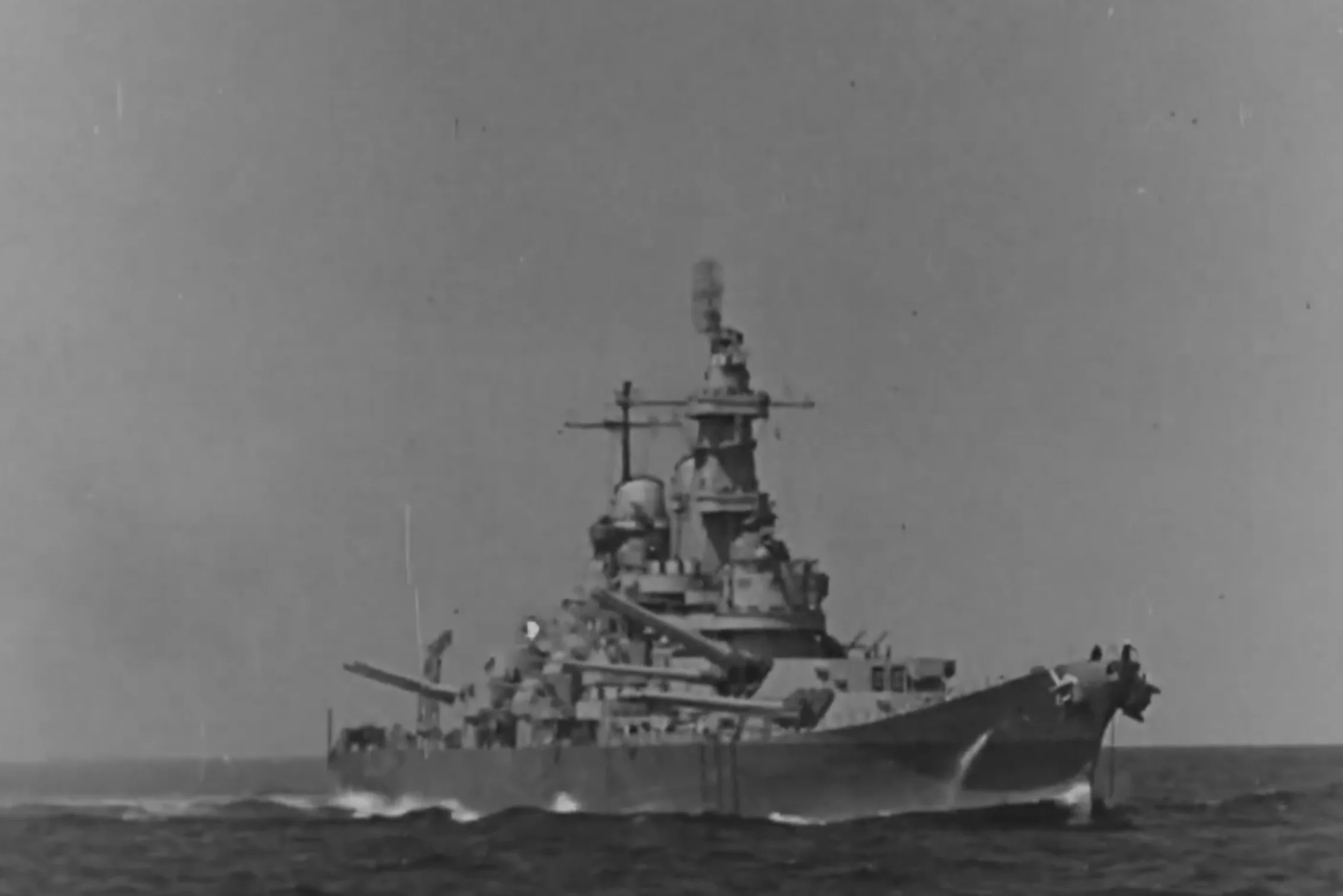
Iowa combined nine 16-inch/50-caliber guns with a designed speed of approximately 33 knots. At 887 feet 3 inches overall, she was built with a long, narrow hull partly shaped by the need to pass through the Panama Canal. Her wartime crew numbered more than 2,700 sailors, although crew size changed substantially during her different periods of service.
Construction and commissioning
Iowa’s keel was laid at the New York Navy Yard in Brooklyn on June 27, 1940. She was launched on August 27, 1942, sponsored by Ilo Wallace, wife of Vice President Henry A. Wallace, and commissioned on February 22, 1943, with Captain John L. McCrea in command.
After shakedown and training in the Atlantic, Iowa briefly operated in northern waters to help guard against a possible sortie by the German battleship Tirpitz.
See NHHC photographs of USS Iowa’s 1943 commissioning
President Franklin D. Roosevelt and the Tehran Conference
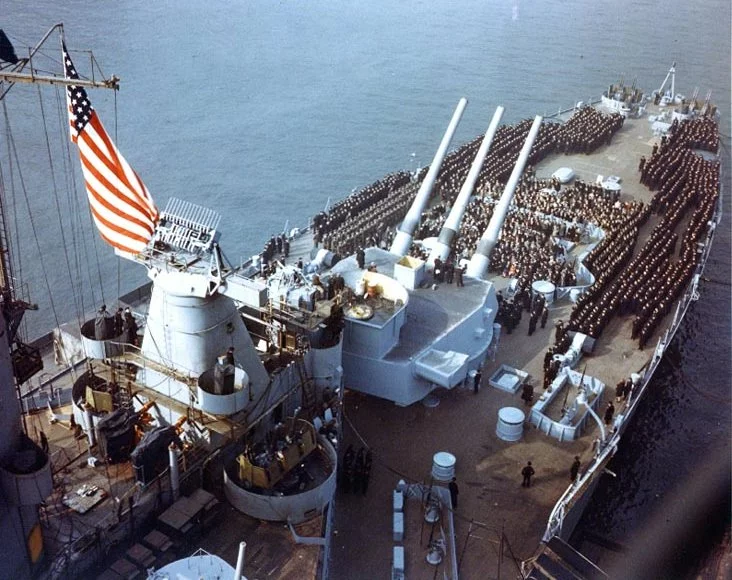
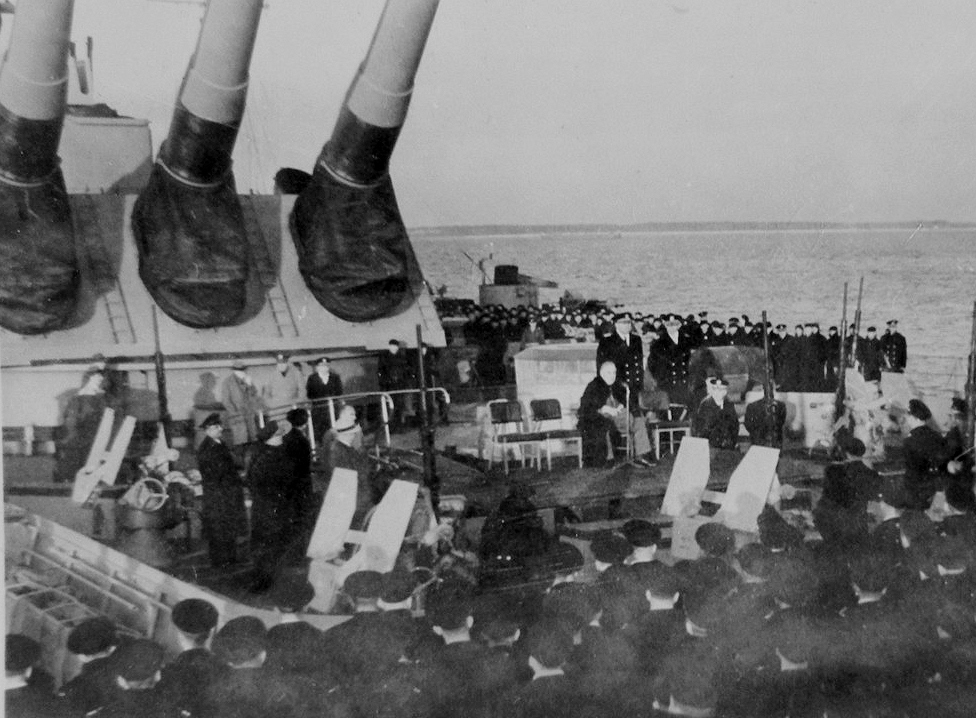
In November 1943, Iowa carried President Franklin D. Roosevelt across the Atlantic on the first part of his journey to meet British Prime Minister Winston Churchill and Soviet leader Joseph Stalin at the Tehran Conference.
The ship was modified for the president’s comfort and mobility, including the installation of a bathtub—an unusual feature aboard a Navy warship. The voyage also produced one of Iowa’s most dramatic early moments. During an antiaircraft exercise, the destroyer USS William D. Porter accidentally launched a live torpedo toward the battleship. Iowa turned sharply and avoided it.
The presidential mission linked Iowa directly to Allied planning for the defeat of Nazi Germany. It also helped establish the nickname by which the ship is widely known today: the Battleship of Presidents.
Victory “Vicky” the Ship’s Mascot
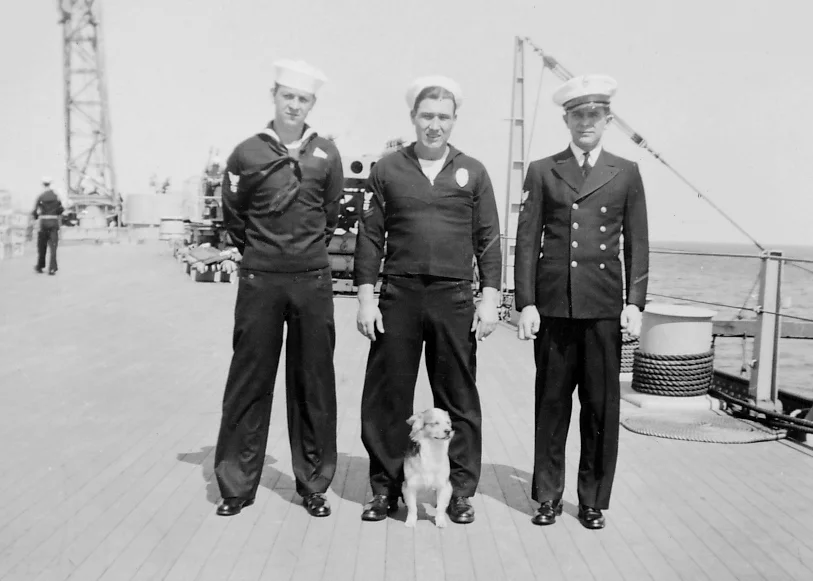
Not every sailor aboard USS Iowa walked on two legs. Victory—affectionately known as “Vicky”—was the battleship’s official mascot during her first period of commission from 1943 to 1949.
Vicky belonged to USS Iowa’s first commanding officer, Captain John L. McCrea, who brought the small mixed-breed dog aboard shortly after the ship entered service. Vicky officially reported for duty as an “apprentice mascot,” complete with identification papers, a service record, paw prints and a specially tailored sailor’s uniform.
The friendly and occasionally mischievous dog quickly became a beloved member of the crew, helping lift sailors’ spirits during the long separations and uncertainty of World War II. Vicky traveled more than 205,000 miles aboard Iowa, crossed the equator and earned recognition connected to the ship’s wartime service.
During President Franklin D. Roosevelt’s secret 1943 voyage aboard Iowa, Vicky reportedly slept at the foot of the president’s bed. He also encountered many of the senior military leaders who traveled aboard or visited the Battleship of Presidents.
When USS Iowa was decommissioned in 1949, Vicky was piped over the side with full honors and reunited with McCrea, by then a vice admiral, in Hawaii.
Read more about Vicky’s story and the fun scavener hunt aboard te ship today.
World War II in the Pacific
Iowa transferred to the Pacific at the beginning of 1944 and joined the fast carrier forces that carried the war toward Japan. Her combination of speed, heavy guns and antiaircraft weapons allowed her to protect aircraft carriers, bombard enemy positions and engage surface targets.
Her World War II operations included:
- Supporting the Marshall Islands campaign, including operations around Kwajalein and Eniwetok.
- Participating in the February 1944 attack on Truk, a major Japanese naval and air base.
- Supporting carrier strikes and amphibious operations across the Central Pacific, including the Marianas, Palaus and Philippines.
- Screening carriers during the Battle of the Philippine Sea in June 1944.
- Participating in the Leyte campaign and the wider Battle of Leyte Gulf in October 1944.
- Surviving Typhoon Cobra in December 1944 before returning to the United States for repairs.
- Supporting the Okinawa campaign and carrier attacks against the Japanese home islands in 1945.
- Bombarding industrial targets on Honshu and Hokkaido during the final weeks of the war.
In August 1945, Iowa became Admiral William F. Halsey Jr.’s flagship. She entered Tokyo Bay and was present on September 2, 1945, when Japan formally surrendered aboard her sister ship USS Missouri.
Iowa earned nine battle stars for World War II service.
Read the official NHHC Dictionary of American Naval Fighting Ships history of USS Iowa (BB-61)
Postwar service and the first decommissioning
After Japan’s surrender, Iowa remained active in the Pacific before returning to the United States. She later served as a training platform and operated with the Pacific Fleet.
With the rapid postwar reduction of American forces, Iowa was decommissioned at San Francisco on March 24, 1949, and placed in reserve. Her time out of service was brief. The outbreak of war in Korea restored a need for the battleship’s long-range naval gunfire.
The Korean War
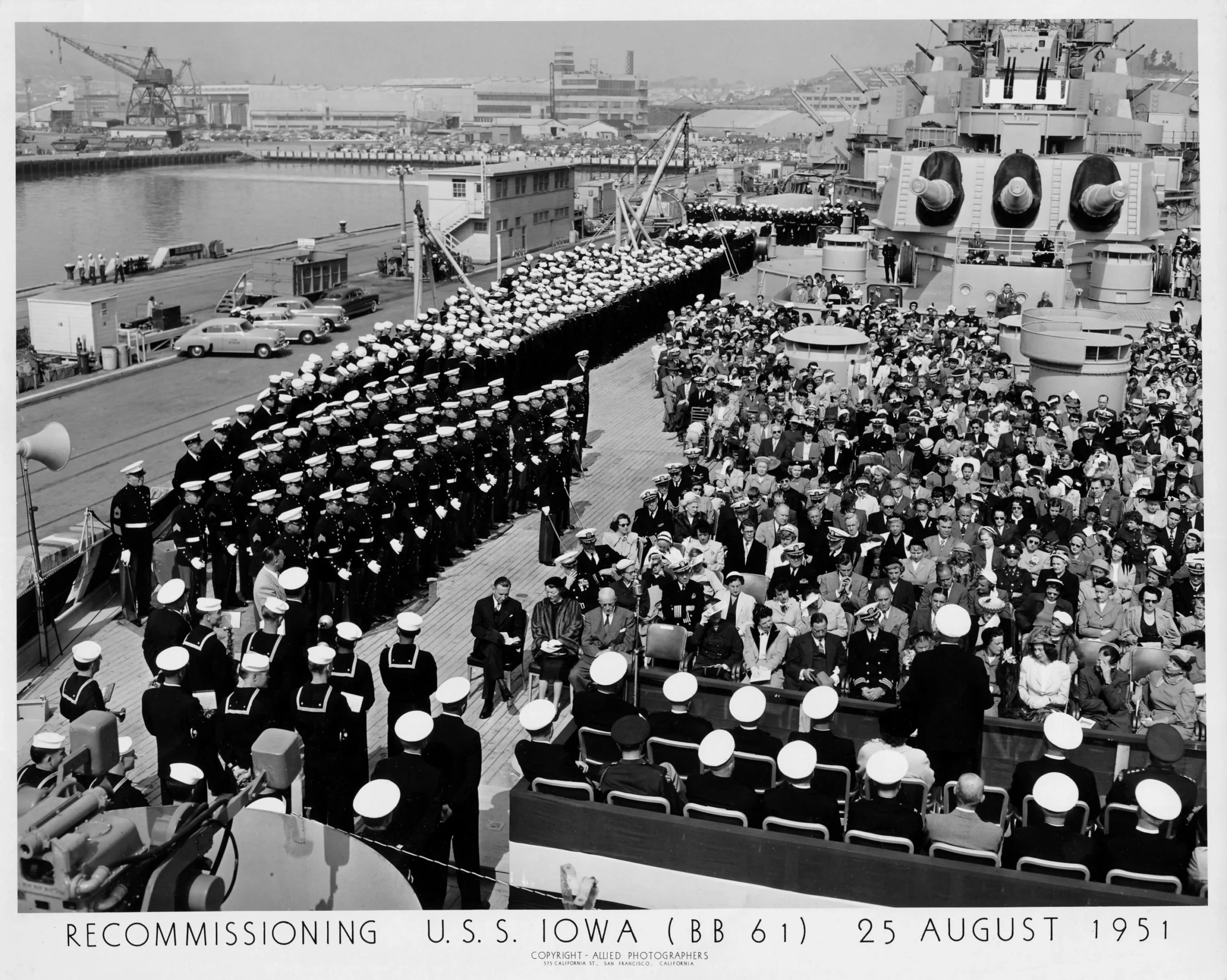
Iowa was recommissioned on August 25, 1951, with Captain William R. Smedberg III in command. After training and preparation, she deployed to Korean waters in 1952 and became flagship of the Seventh Fleet.
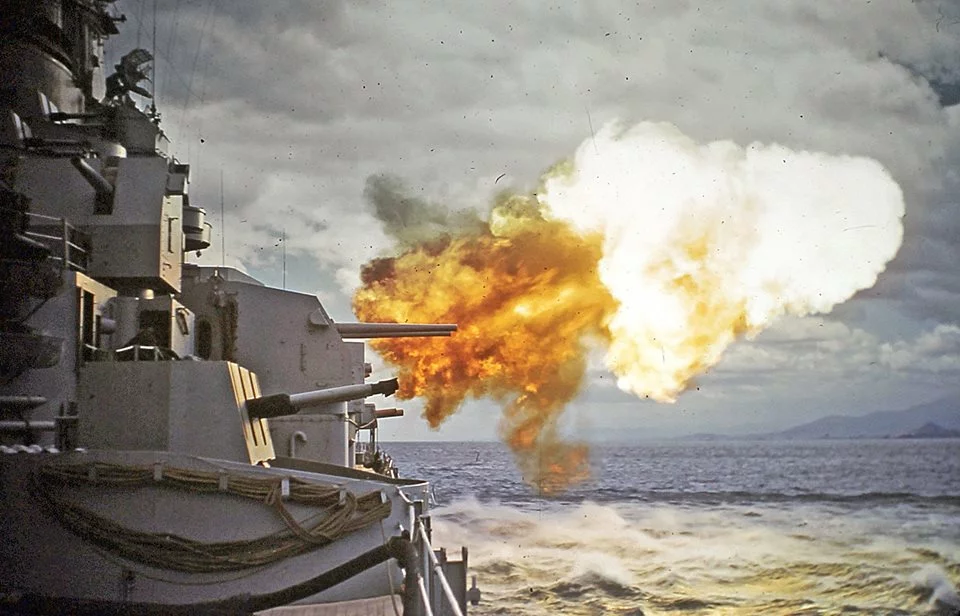
Her 16-inch and 5-inch guns struck transportation networks, supply centers, troop concentrations, bunkers, industrial facilities and coastal positions. Iowa conducted bombardments along Korea’s eastern coast, including operations near Wonsan, Songjin, Hungnam and Kojo. Naval gunfire gave United Nations forces a mobile source of heavy artillery that could strike targets far inland from the coast.
Iowa completed her Korean combat deployment in late 1952 and earned two battle stars for Korean War service, bringing her career total to 11 battle stars.
Peacetime fleet service, 1953–1958
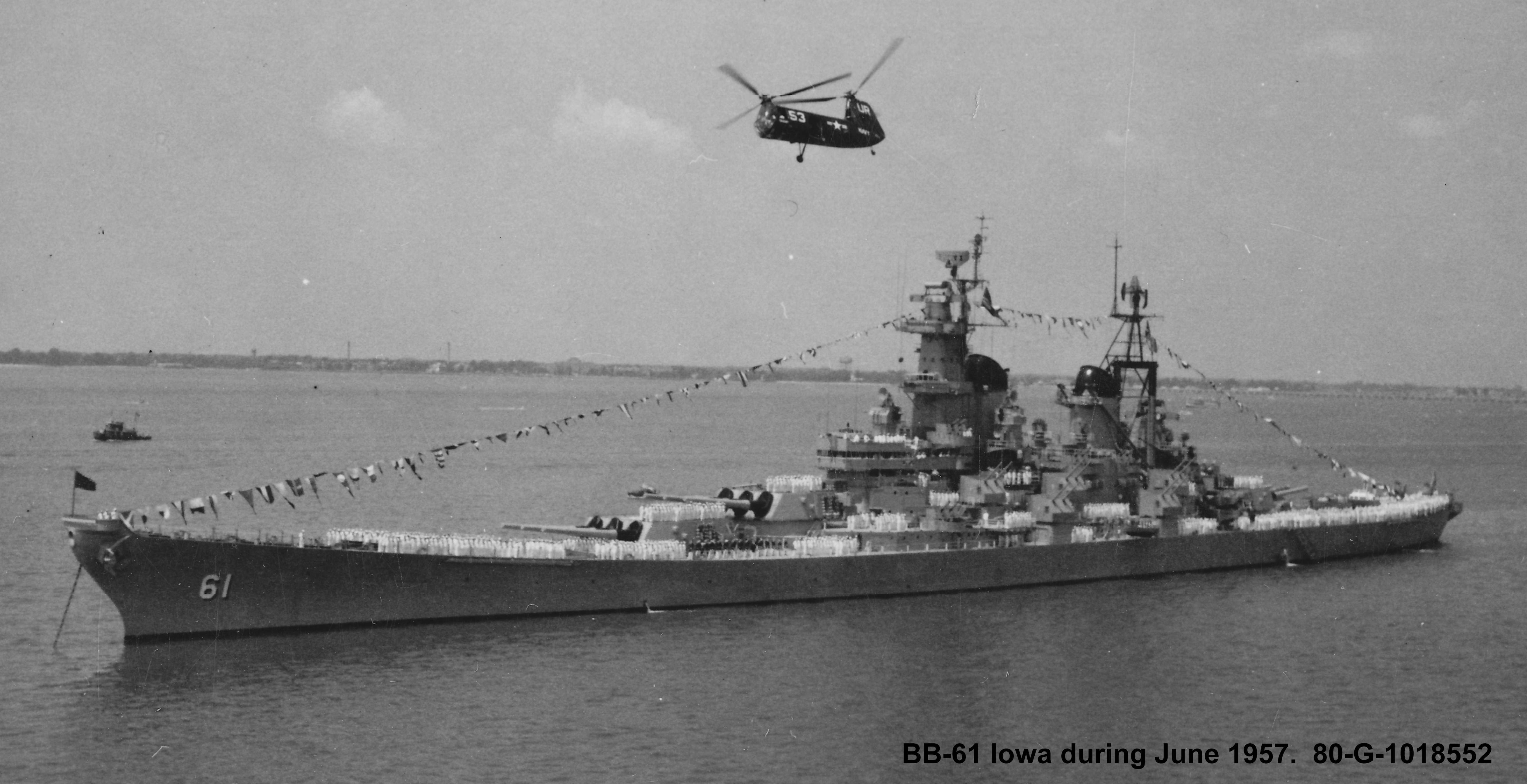
Following Korea, Iowa operated with both the Atlantic Fleet and Sixth Fleet. She participated in NATO exercises, made deployments to northern Europe and the Mediterranean, and carried Naval Academy midshipmen on training cruises.
The Navy decommissioned Iowa again on February 24, 1958, at Philadelphia. She remained in the reserve fleet for more than two decades as aircraft carriers, nuclear submarines and guided missiles became increasingly central to American naval power.
The 1980s: a battleship returns to the fleet
Modernization for a new era
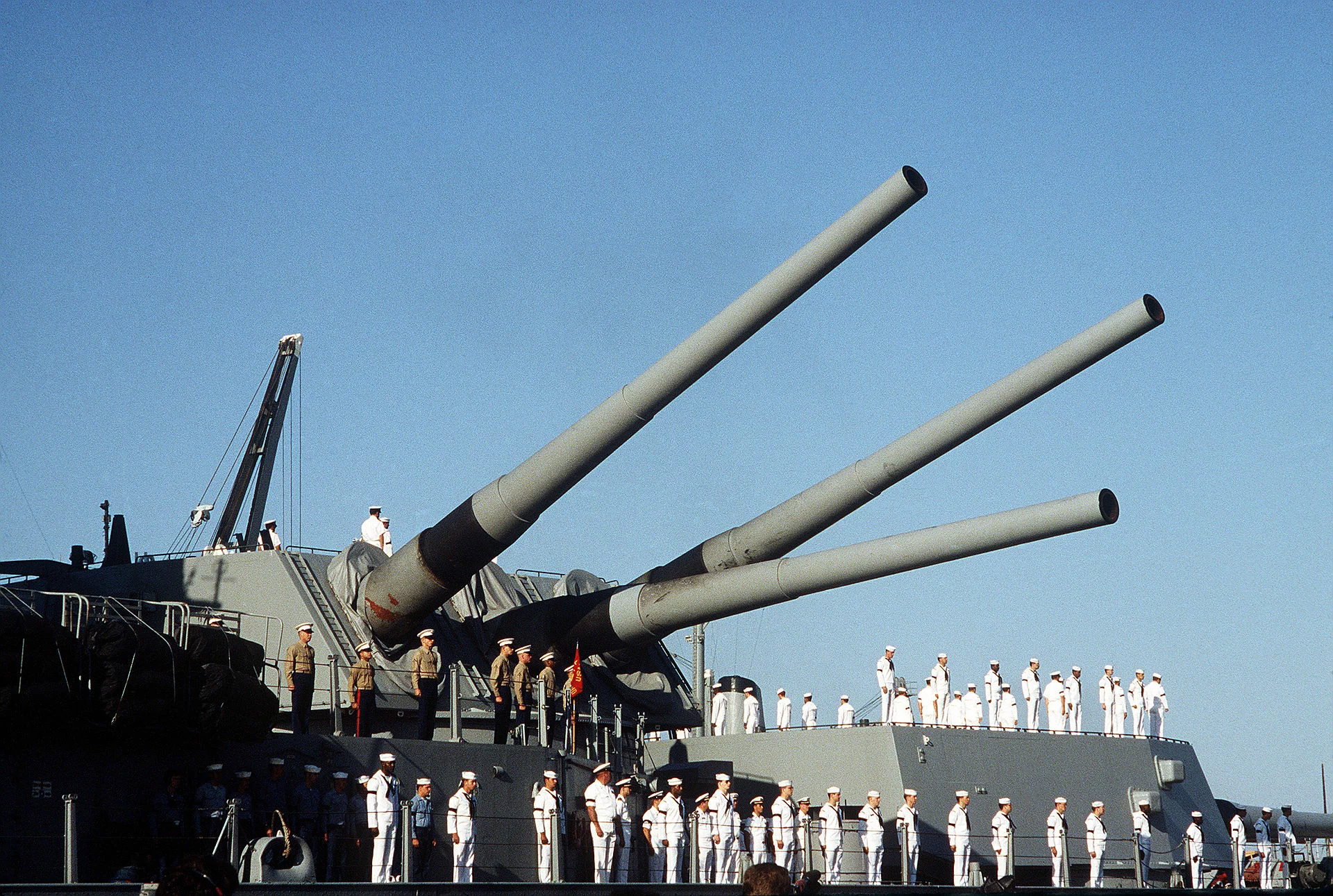
During the 1980s defense buildup, the Navy reactivated all four Iowa-class battleships as part of its drive toward a 600-ship fleet. Iowa underwent an extensive modernization that combined her original heavy guns with modern missiles, sensors and electronic systems.
Her updated weapons included:
- Nine 16-inch/50-caliber guns in three triple turrets.
- Twelve 5-inch/38-caliber guns in six twin mounts.
- Thirty-two Tomahawk cruise missiles in eight armored box launchers.
- Sixteen Harpoon antiship missiles in four quad launchers.
- Four Phalanx close-in weapon systems for defense against aircraft and missiles.
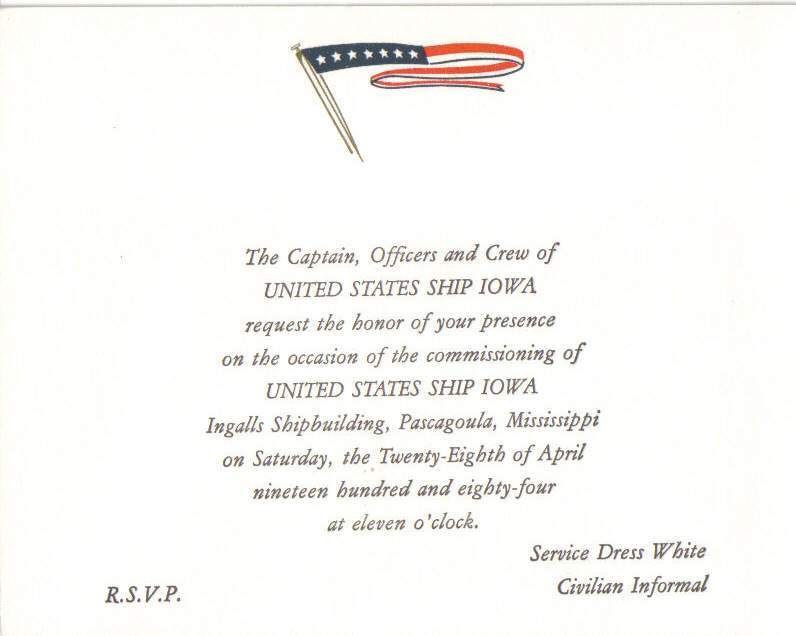
The Navy recommissioned Iowa on April 28, 1984, at Ingalls Shipbuilding in Pascagoula, Mississippi. Vide President George H.W. Bush attended the ceremony.
Those Who Served
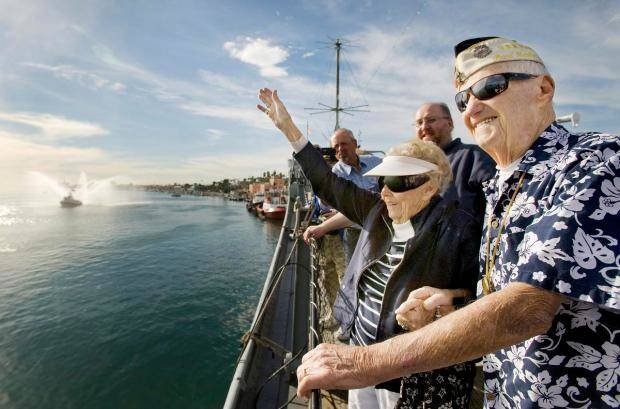
Meet the sailors who served aboard USS Iowa and discover the people, stories, and experiences behind the legendary battleship.
Cold War deployments and Operation Earnest Will
Iowa spent the next several years participating in fleet exercises, showing the flag, supporting NATO operations and deploying to European, Mediterranean, Caribbean and Central American waters.
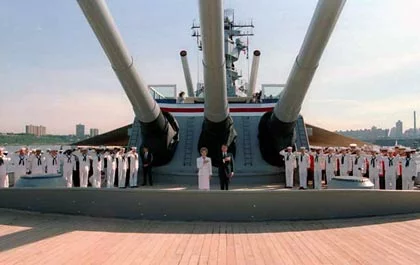
On July 4th, 1986, President Ronald Reagan boarded Iowa to observe the International Naval Review.
In 1987 and 1988, Iowa deployed to the region of the North Arabian Sea and Persian Gulf during Operation Earnest Will, the American effort to protect reflagged Kuwaiti oil tankers during the Iran-Iraq War. The mission demonstrated how a World War II-era hull could still contribute to late-Cold War naval operations after a major technological modernization.
Contrary to a claim repeated in some later summaries, USS Iowa (BB-61) did not serve in the Vietnam War. Her sister ship USS New Jersey (BB-62) was the Iowa-class battleship that conducted combat operations off Vietnam.
April 19, 1989: the Turret 2 tragedy
At approximately 9:50 a.m. on April 19, 1989, an explosion tore through the center gun room of Iowa’s Number Two 16-inch gun turret during a gunnery exercise northeast of Puerto Rico. The explosion and fire killed 47 sailors.
The crew’s immediate actions helped prevent an even greater disaster. Sailors flooded the turret’s powder magazines to stop the fire from reaching additional propellant. The loss remains one of the deadliest peacetime accidents in modern U.S. Navy history.
The Navy’s initial investigation generated substantial controversy, particularly its attempt to attribute the explosion to a deliberate act. A later technical investigation by Sandia National Laboratories demonstrated that an overram of the powder bags could have caused the explosion. The Navy subsequently stated that there was insufficient evidence to establish that the explosion had been intentional and apologized to the family of Gunner’s Mate Second Class Clayton Hartwig, whom the initial investigation had accused.
The 47 sailors lost in Turret 2 remain central to Battleship IOWA’s story. They are honored aboard the ship and remembered each year on April 19.
Read the Naval Safety Command summary of the USS Iowa explosion
View the Battleship IOWA Museum’s remembrance of the Iowa 47
Final decommissioning and reserve status
Iowa completed another deployment after the Turret 2 tragedy, serving as Sixth Fleet flagship in the Mediterranean during part of 1989. Turret 2 was never returned to service.
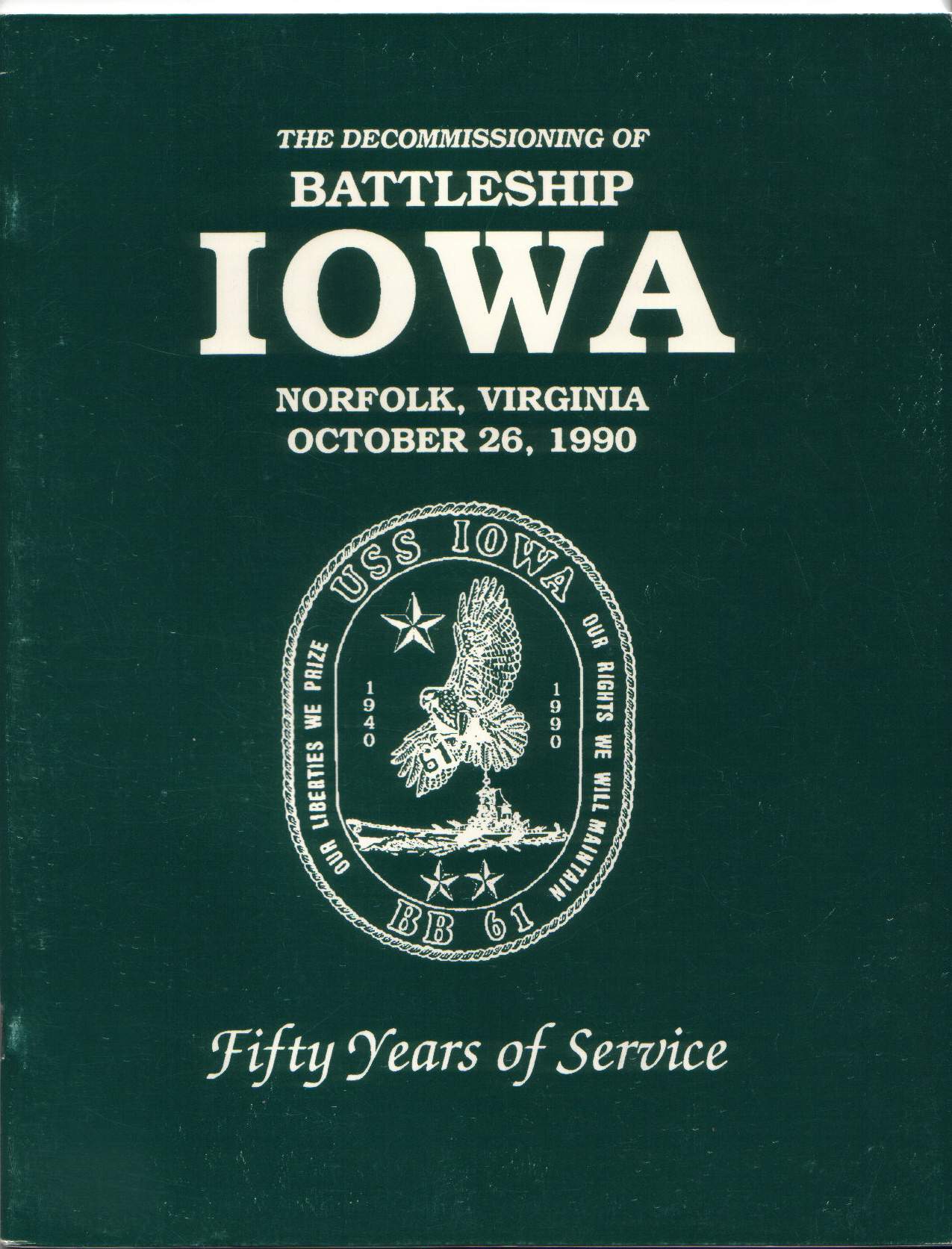
The battleship was decommissioned for the final time at Norfolk, Virginia, on October 26, 1990. She later moved through reserve-fleet locations on both coasts. Iowa was removed from the Naval Vessel Register in 1995, restored to the register in 1999 under congressional requirements that preserved battleship naval-gunfire capability, and finally stricken on March 17, 2006, opening the way for donation as a museum.
The Navy’s historical evaluation found Iowa eligible for listing in the National Register of Historic Places. It recognized the ship as the lead vessel of the last class of American battleships, a presidential transport, a combat veteran of World War II and Korea, and a participant in Operation Earnest Will.
Read the Navy’s final historical evaluation of USS Iowa
Saved by civilians: Battleship IOWA comes to Los Angeles
After years in the reserve fleet, the future of Iowa depended on a civilian-led preservation effort. The nonprofit Pacific Battleship Center developed a plan to bring the ship to the Port of Los Angeles and open her to the public.
On September 6, 2011, the Navy selected Pacific Battleship Center to receive Iowa for permanent berthing and public display in San Pedro, California. The ship was moved from the Suisun Bay Reserve Fleet to the Port of Richmond for preservation work. The Navy formally transferred ownership to Pacific Battleship Center on April 30, 2012.
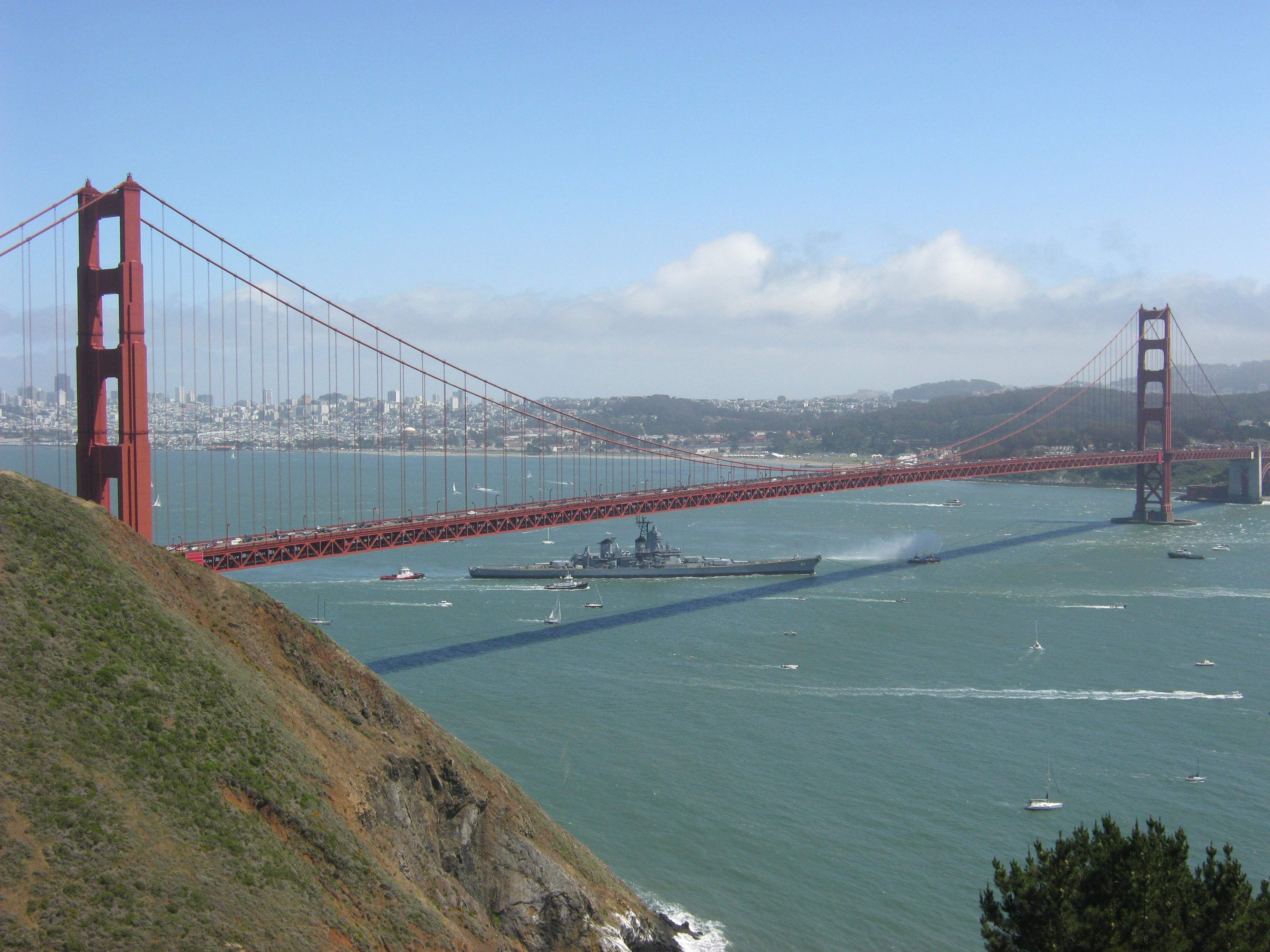
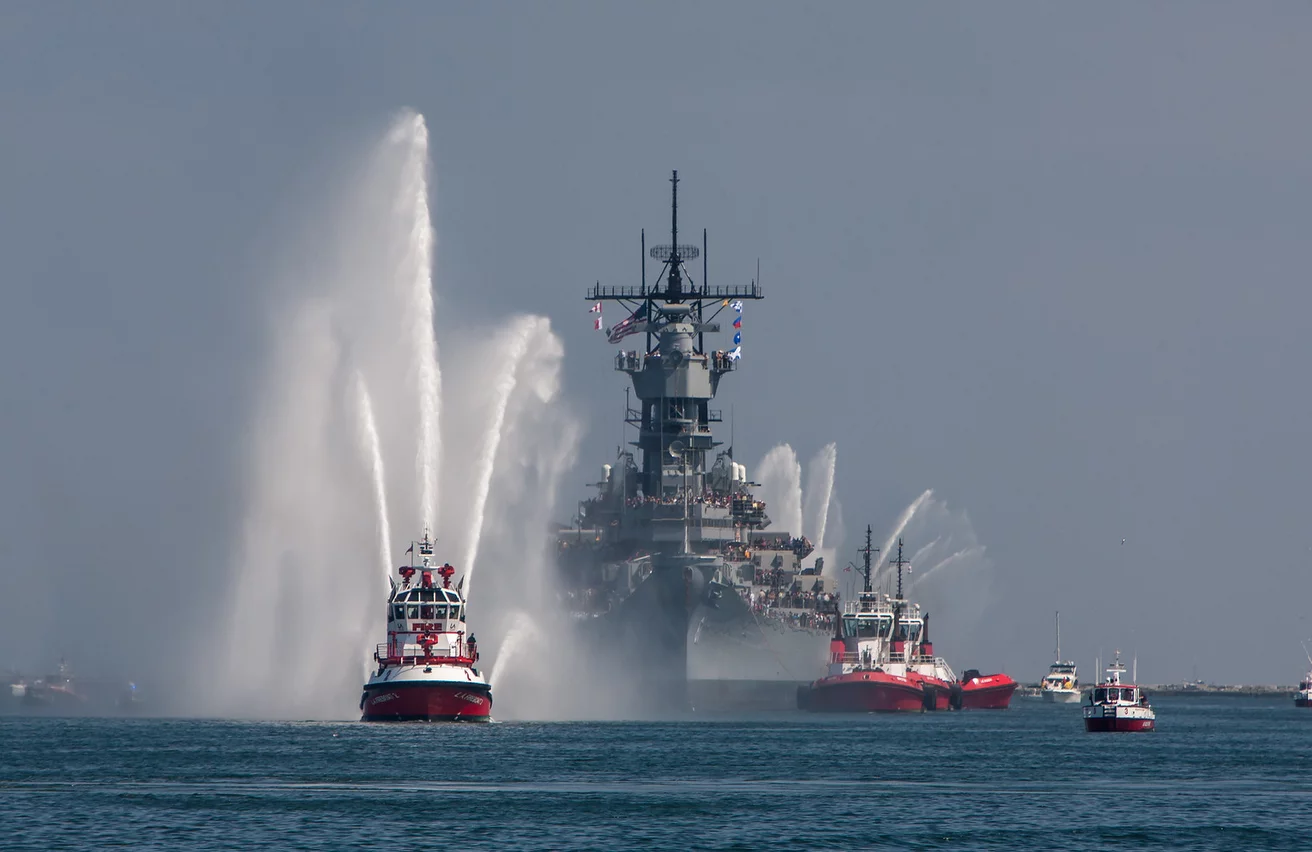
After work in Richmond, Iowa was towed south along the California coast. She arrived at the Port of Los Angeles on June 9, 2012, and opened to the public on July 7, 2012.
Read the Navy’s 2011 announcement selecting Pacific Battleship Center
Battleship IOWA today
Battleship IOWA is now preserved on the Los Angeles Waterfront in San Pedro. The ship is maintained and operated by Pacific Battleship Center, an independent nonprofit organization—not the U.S. Navy or another government agency.
Iowa is more than a preserved warship. She is the historic platform of the National Museum of the Surface Navy, the congressionally designated museum dedicated to the men and women of America’s Surface Navy. Through the museum’s Life of a Sailor experience, visitors explore how sailors lived, worked, trained and served aboard Navy ships.
During her time on the Los Angeles Waterfront, the Battleship IOWA continued its legacy as the Battleship of President’s, hosting President Donald Trump and President Joe Biden.
The ship’s continuing public service includes education, veterans programs, community events, preservation, remembrance and the interpretation of naval history. Her survival makes it possible for new generations to walk the decks where sailors served during World War II, Korea and the Cold War.
Plan a visit to Battleship IOWA
After BB-61: USS Iowa (SSN-797)
The Iowa name returned to active naval service with USS Iowa (SSN-797), a Virginia-class nuclear-powered fast-attack submarine. Secretary of the Navy Ray Mabus announced the name in 2015.
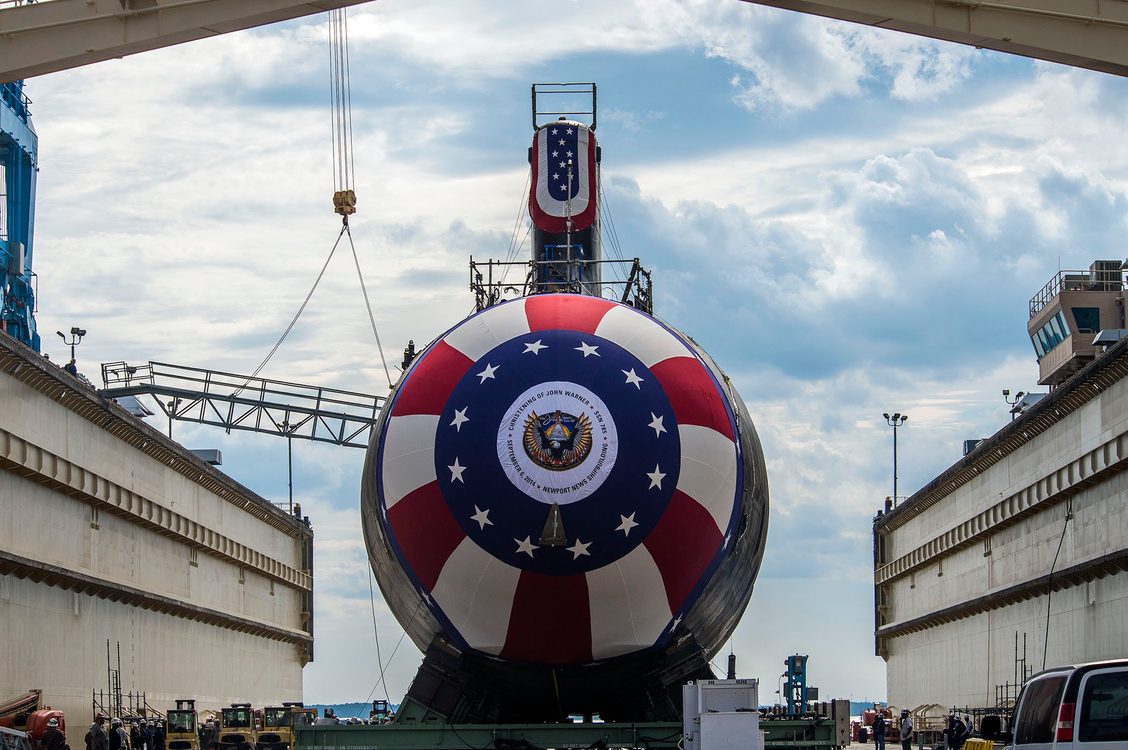
Iowa’s keel was authenticated on August 20, 2019, and the submarine was christened on June 17, 2023, with former Iowa first lady Christie Vilsack serving as sponsor. The Navy accepted delivery on December 21, 2024.
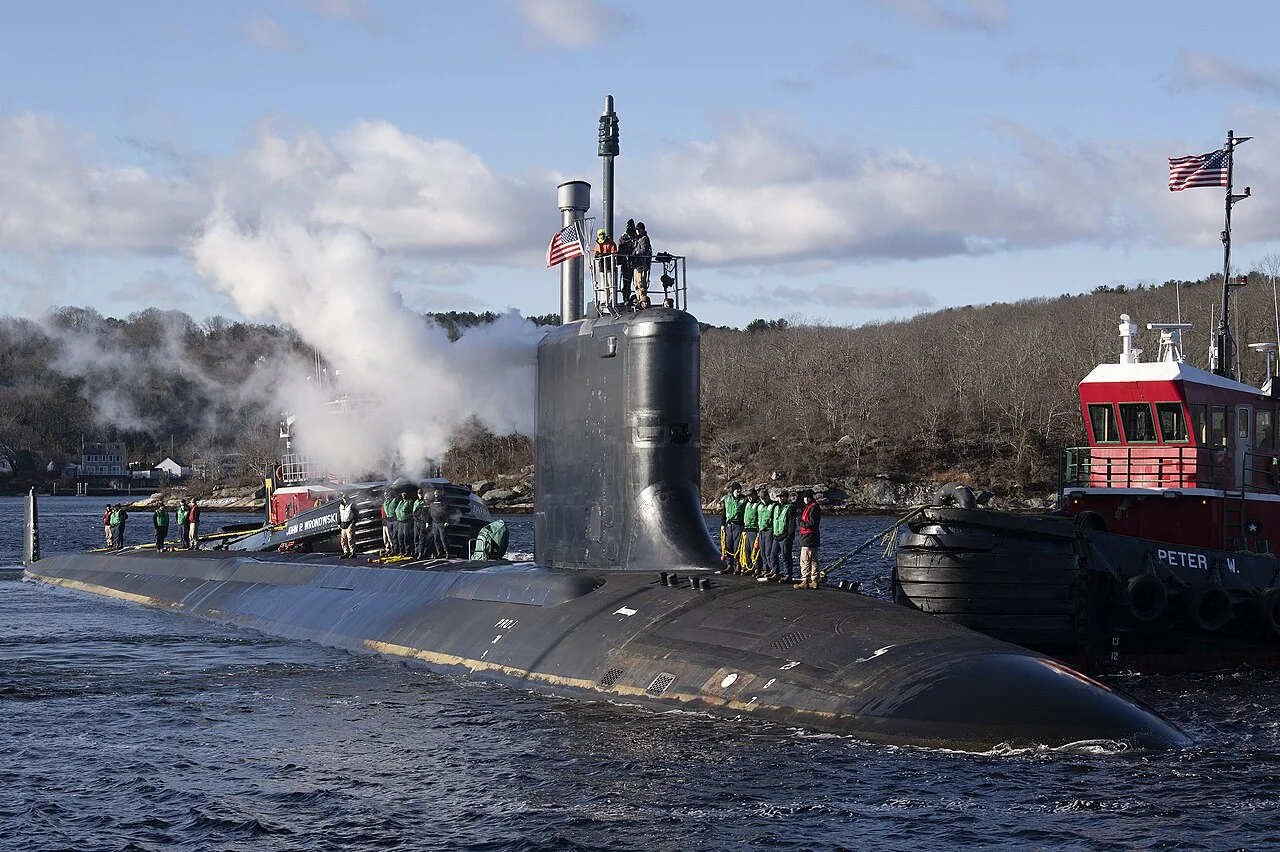
USS Iowa was commissioned at Naval Submarine Base New London in Groton, Connecticut, on April 5, 2025. She became the fifth naval vessel assigned the Iowa name, the third commissioned as USS Iowa, and the first submarine named for the Hawkeye State.
SSN-797 represents a dramatic technological contrast with BB-61. The 377-foot Virginia-class submarine displaces approximately 7,800 tons submerged and is designed for missions including antisubmarine warfare, antisurface warfare, intelligence collection, surveillance, reconnaissance and support of special operations.
The commissioning of SSN-797 did not end BB-61’s identity as Battleship IOWA. One is an active submarine and the other a preserved battleship, each identified by its unique hull number. Together, they connect the historic Surface Navy with the modern undersea force.
Visit the official USS Iowa (SSN-797) website
Curator’s Corner
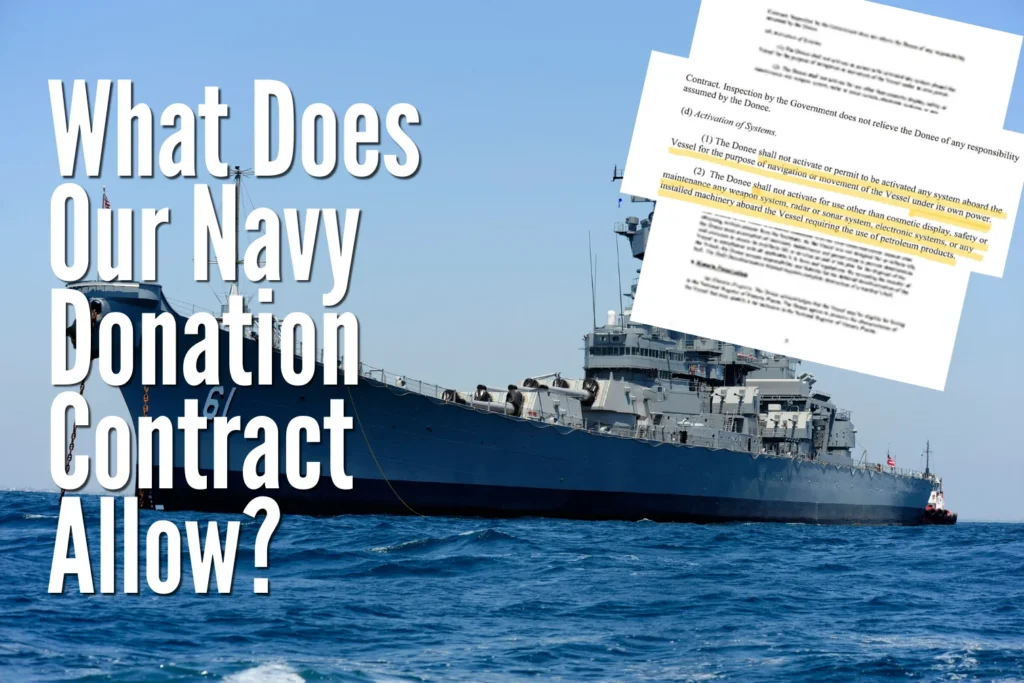
Did We Need Permission From The Navy To Turn A Turret?
Did we need permission from the Navy to turn a turret? What’s in our donation contract?
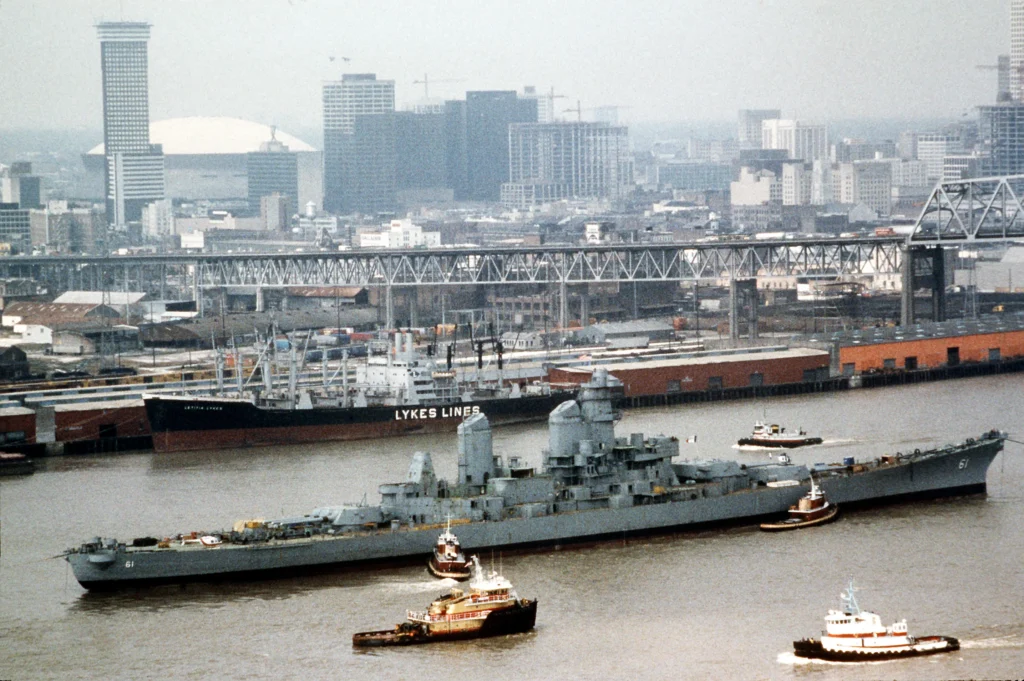
What Would It Take to Move Battleship IOWA to the State of Iowa?
Could Battleship IOWA ever reach the state whose name she carries? Explore how bridges, river depth, locks, federal law and billions in potential costs […]
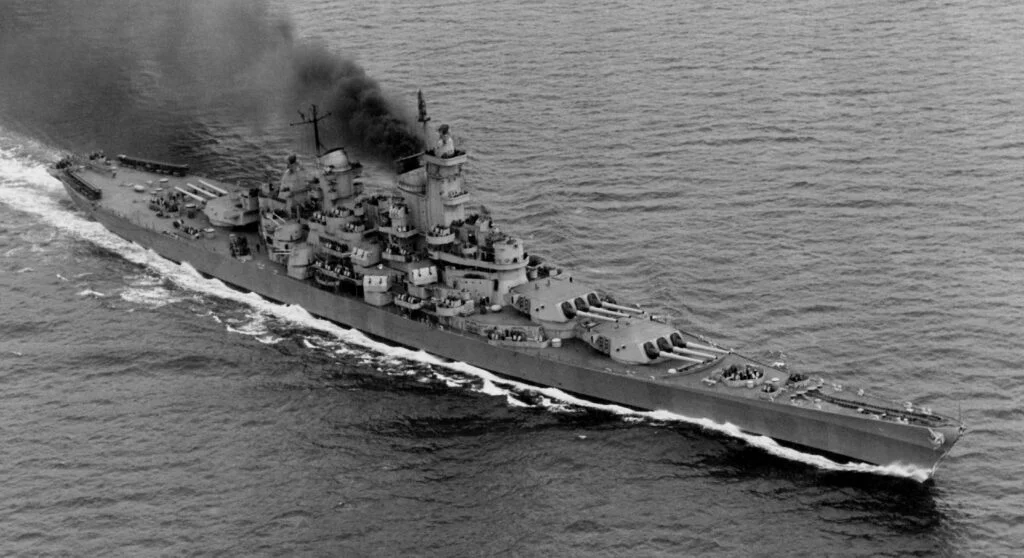
Why is Battleship IOWA one of the most significant battleships in American history?
Explore why Battleship IOWA is one of America’s most significant warships—a living record of World War II, Korea, the Cold War, presidential history, technological […]
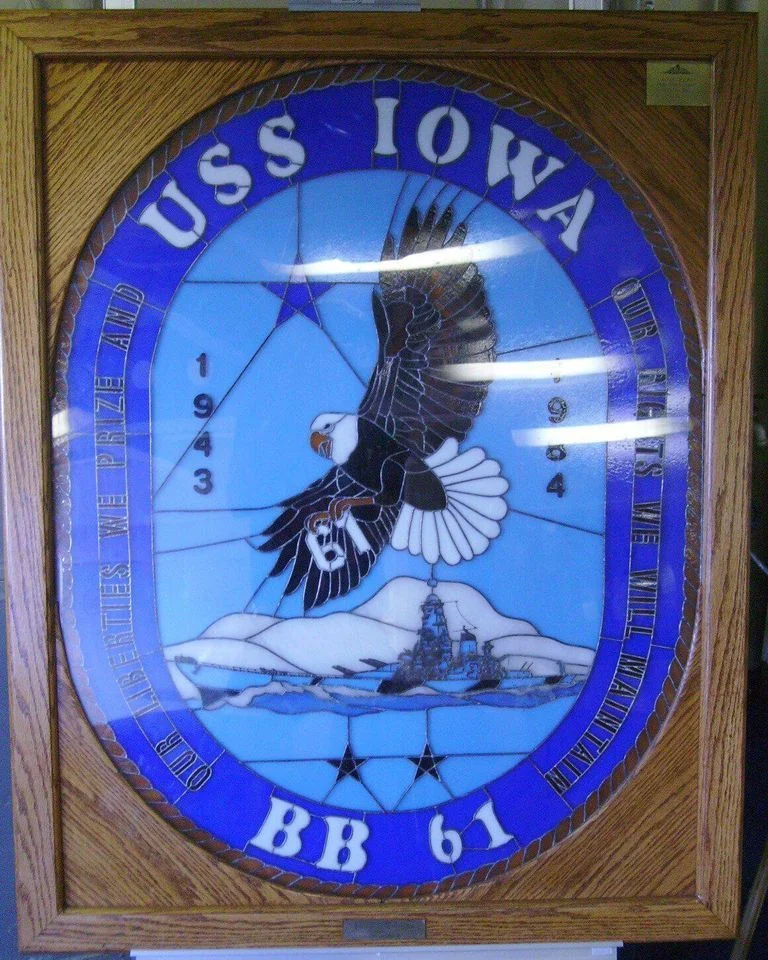
What Can A Museum Collection Tell Us That A Battleship Alone Cannot?
Battleship IOWA may be the largest artifact in the collection, but she cannot tell her entire story alone. Discover how photographs, personal objects, documents, […]
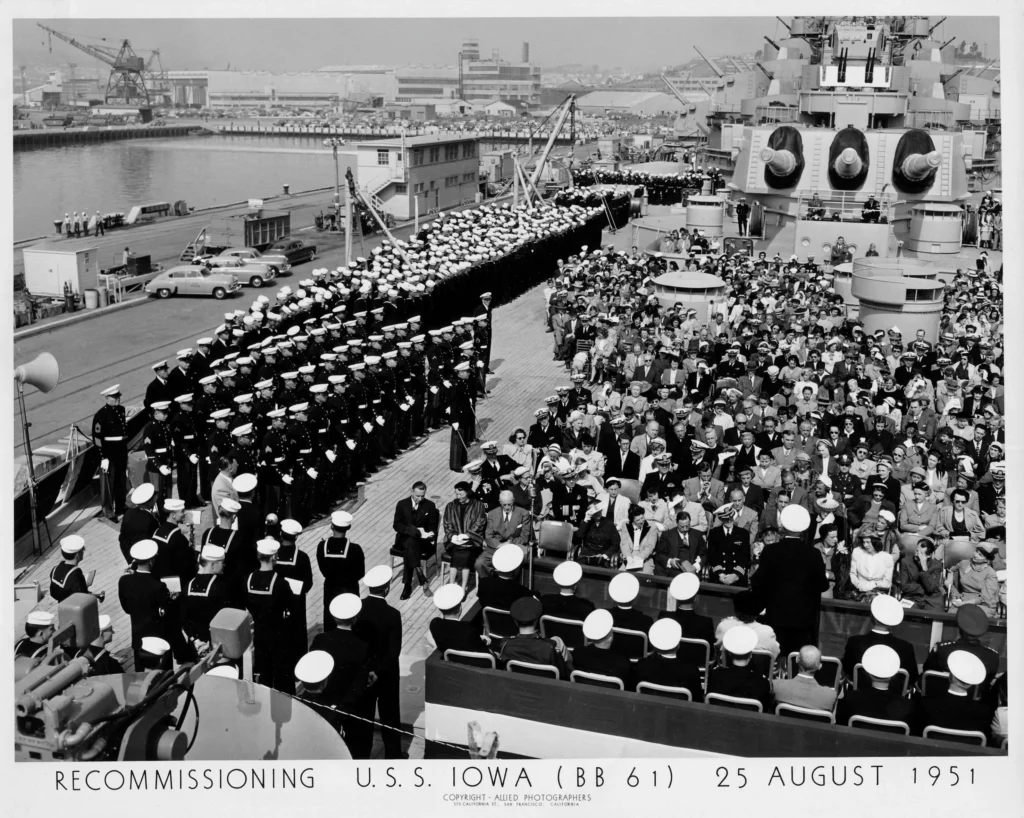
IOWA recommissioning ceremony August 25, 1951 / the Korean War
New Collection Added to Battleship IOWA’s Archives: Photographs and Written Memories from the Korean War Commissioning Lt. Robert McKinnell served aboard BB-61 as Assistant […]
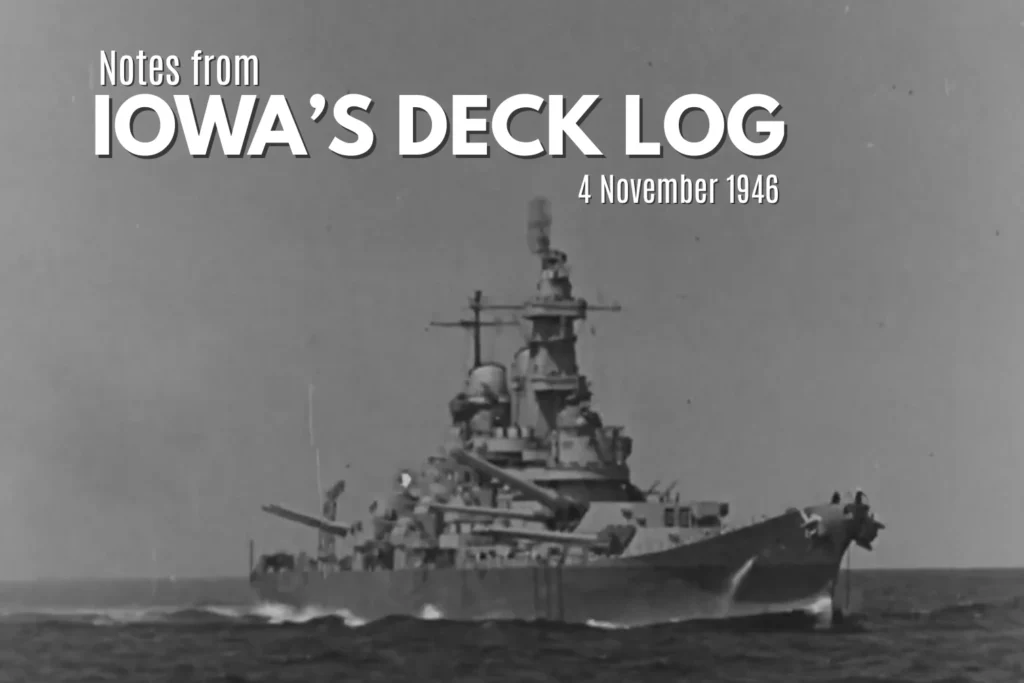
Happy 83rd Birthday, IOWA!
February 22, 2026 marks the 83rd anniversary of BB-61’s original commissioning. To commemorate the occasion, Battleship IOWA’s historian/curator Dave Way dug into his archives […]
“Oh Those Float Planes…”
Excerpt from IOWA’s deck log: “Oh, those float planes”

Headlines from the End of World War II
Memories on the 80th anniversary of the end of World War II